
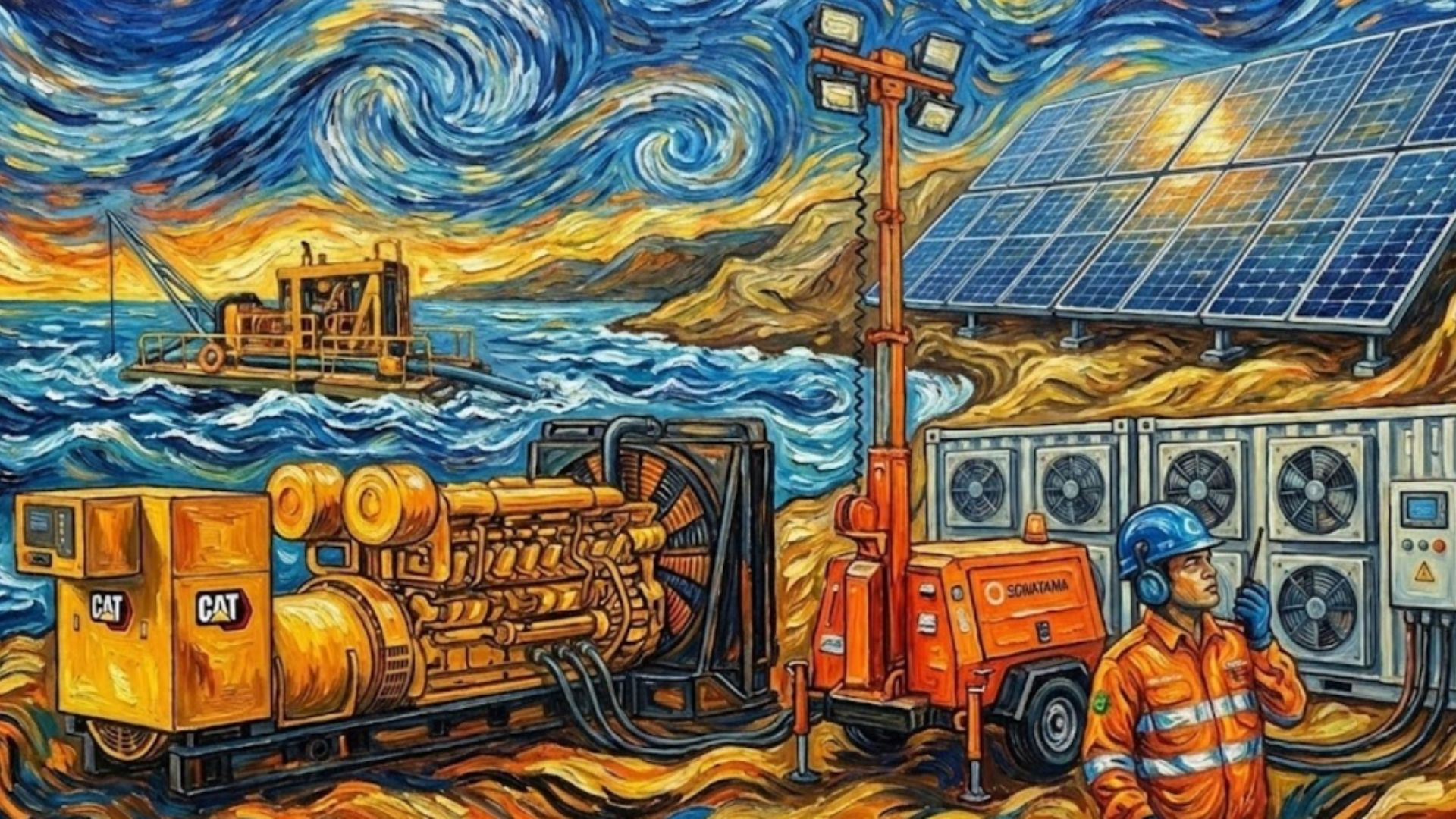
How Will Generator Set Requirements Evolve in the Future?
Amid Indonesia’s accelerated push toward its Net-Zero Emission targets, a pragmatic reality is emerging: reliance on generator sets (gensets) is transforming. Gensets are no longer positioned merely as emergency backups, but as pillars of operational stability and instruments of bioenergy-based energy sovereignty within the implementation of the RUPTL 2025–2034.
Geographical Mismatch
The government has designated the RUPTL 2025–2034 as the single guiding framework for Indonesia’s electricity sector. Under this plan, by 2034, Indonesia aims to add 69.5 GW of power capacity, with 76 percent of the capacity sourced from New and Renewable Energy (NRE).
However, achieving this target comes with significant challenges. Indonesia’s archipelagic geography is one of the most critical. According to Evy Haryadi, Director of Technology, Electricity, and Sustainability at PT PLN (Persero), in his presentation at Electricity Connect 2025 late last year, the greatest challenge lies in geographical mismatch: abundant green energy potential exists, but it is often located in isolated areas, far from major load centres such as large cities and industrial zones.
To address this, the core strategy outlined in the RUPTL 2025–2034 is the development of a Green Enabling Super Grid. The concept is to interconnect major islands so that renewable energy generated in remote areas can support demand in large urban centres. Conversely, electricity surpluses in one region can be transmitted to regions experiencing deficits.
Unfortunately, this plan requires substantial time and capital investment. Based on technical data, large-scale interconnection projects typically take between 8 and 11 years to complete. A report by the Institute for Essential Services Reform (IESR) in the Indonesia Energy Transition Outlook 2025 notes that grid expansion into remote and underdeveloped regions (3T areas) continues to face massive logistical and cost challenges.
Smart Microgrids
One solution to these constraints is currently being piloted by the government through PT PLN (Persero) with the development of Smart Microgrids, such as the project in Nusa Penida, Bali. The concept integrates non-renewable power plants, such as diesel power plants (PLTD), with renewable energy-based generation.
As a result, 26 diesel generator units in Nusa Penida now operate in synergy with solar photovoltaic systems (PLTS 3.6 MWp) and battery energy storage systems (BESS 1 MW). In this configuration, gensets assume the role of load followers. Given the intermittent nature of solar energy, gensets must be ready to enter the system within seconds to maintain voltage and frequency stability. Without the flexibility provided by these diesel units, the microgrid system would be highly vulnerable to frequency disturbances, posing serious risks to sensitive electronic equipment used by industries and households.
Power Stability
For industries, a stable electricity supply is non-negotiable. Referring to McKinsey & Company’s Global Energy Perspective 2025, the demand for uninterrupted power supply (zero downtime) is becoming increasingly critical alongside the rapid growth of the digital economy. The report highlights that electricity demand from data centres will continue to rise sharply. Indonesia, now one of Southeast Asia’s fastest-growing data centre hubs, has no tolerance for power disruptions.
Similarly, for industrial operators and hospitals, the availability of on-site power through genset units is a mandatory standard. Even as the national grid continues to strengthen, technical failures and external risks will always exist. Bloomberg NEF’s analysis in the Indonesia Transition Factbook 2025 reinforces that before battery technology reaches widespread economic viability, gensets will remain the most reliable backup solution to mitigate financial losses caused by operational downtime.
“Green” Fuels
An often-overlooked aspect is how genset fuel itself is evolving. Following the implementation of B40 biodiesel in early 2025, the government is now moving toward mandating the use of B50 biodiesel blends.
The Minister of Energy and Mineral Resources, Bahlil Lahadalia, in outlining national energy policy directions for 2025–2026 across various forums, emphasized that strengthening biodiesel utilization is key to reducing dependence on imported diesel fuel.
PLN data shows that by September 2025, biofuel consumption for power generation had reached 3.3 gigalitres. This indicates that today’s operating gensets are increasingly powered by biodiesel, which not only reduces carbon emissions but also strengthens national foreign exchange resilience.
A Bridge to the Future
Viewed through the lens of the RUPTL 2025–2034, Indonesia’s energy transition is not a rushed “break” from legacy technologies. Instead, it is a symphony of integration. Independent power units such as gensets have proven themselves not as obstacles, but as robust bridges.
Their presence ensures that while the Super Grid is under construction and renewable energy technologies are being scaled up, the pulse of the national economy does not falter. If interconnections have yet to reach every corner of the archipelago, gensets, supported by B50 biofuel, will remain steadfast guardians of Indonesia’s energy reliability.
The energy transition is a marathon, not a sprint, and at every kilometre, we still need the most reliable machines to ensure we reach the finish line without power disruptions.
By: Rizka S. Aji, Marketing Communication Specialist, PT. Sumberdaya Sewatama.
Related News
Inform Us What You Need
It pleased us to provide you with solution
