
Biogas Is No Longer a Side Project
The role of biogas in supporting Indonesia's Net Zero Emissions ambitions has evolved far beyond waste management. Today, the Government of Indonesia increasingly views biogas as a strategic component of the country's long-term energy security agenda.
Among Indonesia's renewable energy resources, one of the largest untapped opportunities lies in Palm Oil Mill Effluent (POME), the wastewater generated during palm oil processing. Through anaerobic digestion technology, this organic waste stream can be converted into biogas and subsequently utilized for electricity generation.
During a policy discussion with Satya Widya Yudha, Member of Indonesia's National Energy Council (DEN), on 27 July 2026, as well as presentations delivered by the Directorate of Bioenergy under the Ministry of Energy and Mineral Resources (MEMR), it became evident that bioenergy, including biogas, is no longer regarded as a supplementary initiative. Instead, it has become an integral part of Indonesia's energy transition roadmap toward 2060.
Under Government Regulation (PP) No. 40 of 2025 on National Energy Policy (KEN), bioenergy has been designated as one of the key pillars supporting Indonesia's future energy mix and decarbonization strategy.
Biogas: Turning Waste into Energy.
Biogas is produced through the anaerobic decomposition of organic matter by microorganisms. Its primary components are methane (CH₄) and carbon dioxide (CO₂). The methane content can be used as a renewable fuel for power generation, thermal applications, or upgraded into higher-value products such as biomethane and Bio-CNG.
Speaking at the AgriWaste to Value Conference held at the JW Marriott Hotel Jakarta on 22-23 July 2026, Dr. M. Windrawan Inantha highlighted that POME is one of the most significant sources of methane emissions within the palm oil industry.
Research on Indonesia's palm oil waste streams further underscores this potential. An indicative assessment of the country's 2024 palm oil residue generation estimated annual POME production at between 120 million and 181 million cubic metres, with a midpoint estimate of approximately 144.5 million cubic metres per year. The calculation was based on Indonesia's crude palm oil (CPO) production of 48.16 million tonnes and a POME generation factor ranging from 2.5 to 3.75 cubic metres per tonne of CPO produced.
These figures illustrate why POME can become a significant contributor to Indonesia's renewable energy landscape while simultaneously supporting national decarbonization efforts.
For decades, palm oil producers have primarily viewed POME as an environmental management challenge. However, growing evidence suggests that it should also be seen as an energy asset. Studies by Indonesia's National Research and Innovation Agency (BRIN) and industry stakeholders indicate that every tonne of Fresh Fruit Bunches (FFB) processed generates approximately 0.5 tonnes of POME. With Indonesia producing around 250 million tonnes of FFB annually, the country could generate roughly 125 million tonnes of POME every year.
Without proper treatment, this waste stream can become a significant source of greenhouse gas emissions. Due to its high organic content, untreated POME decomposes in open lagoons and releases methane, a greenhouse gas with a substantially greater global warming potential than carbon dioxide.
Conversely, when methane is captured through biodigesters or covered lagoon systems, the same emission source can be transformed into a valuable form of renewable energy. This creates tangible benefits not only for palm oil producers but also for surrounding communities and the broader energy system.
Four Tangible Benefits for the Palm Oil Industry
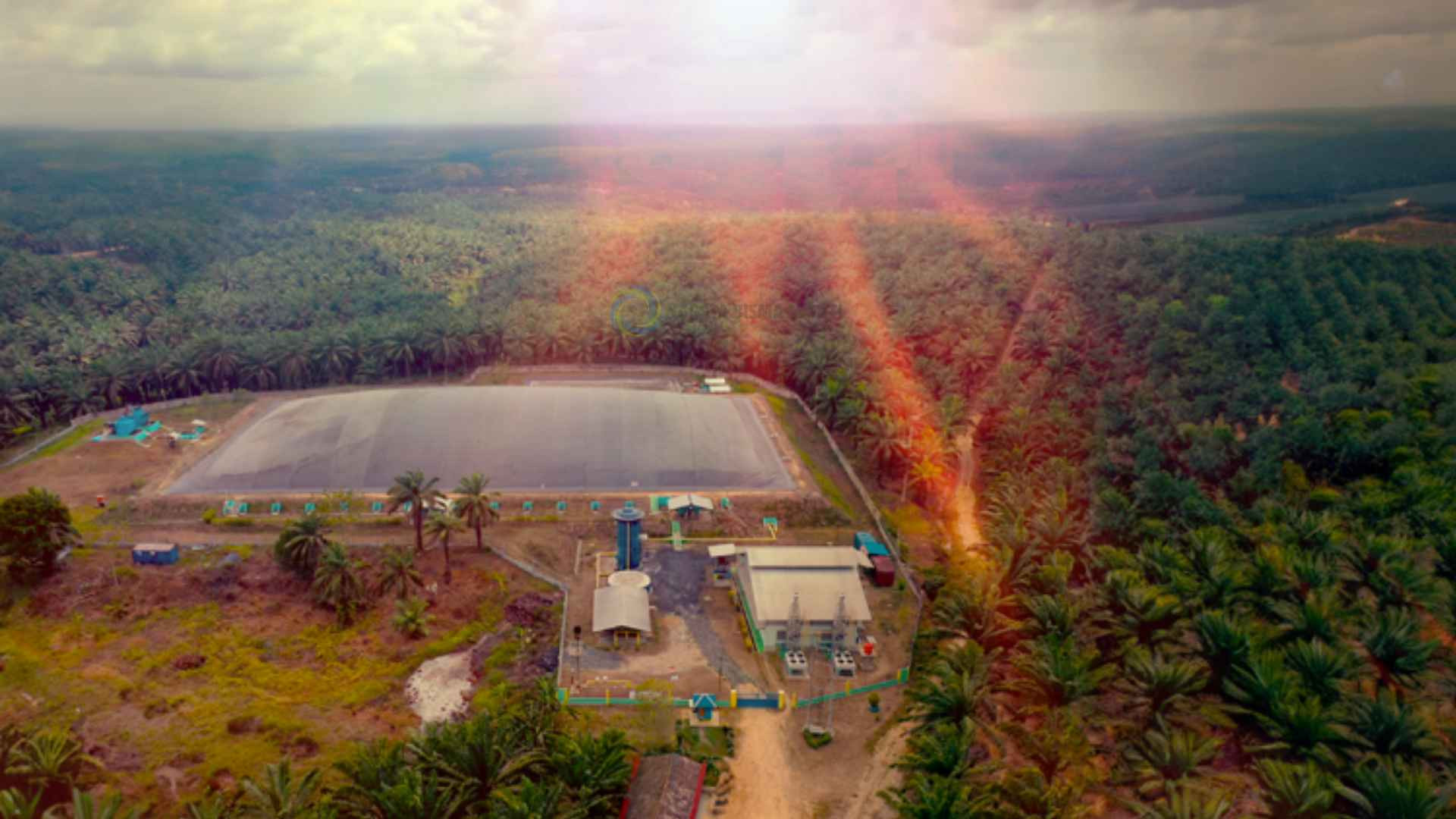
A practical example can be found in South Kalimantan, where PT Sumberdaya Sewatama, through its subsidiary PT Nagata Bisma Shakti, has successfully implemented POME-to-energy infrastructure.
Since 2016, the company has developed, operated, and maintained a 2.4 MW biogas power plant (PLTBg) utilizing POME from a palm oil mill. Building on a decade of operational experience, Sewatama is currently constructing a second 1.2 MW biogas power plant near the original facility.
The project demonstrates that POME-based power generation delivers value well beyond waste treatment.
1. Reduced Operating Costs.
Many palm oil mills are in remote areas where electricity supply depends heavily on diesel generators. Biogas offers a locally available and renewable alternative, reducing dependence on fossil fuels and improving long-term energy cost efficiency.
2. Improved Environmental Compliance.
Methane capture helps operators meet increasingly stringent environmental requirements while reducing the risk of wastewater-related pollution. At the same time, global markets are placing greater emphasis on products with lower carbon footprints and demonstrable sustainability performance.
3. Support for Sustainability Certification
Sustainability certification schemes such as Indonesian Sustainable Palm Oil (ISPO) and Roundtable on Sustainable Palm Oil (RSPO) increasingly evaluate greenhouse gas management, waste handling, and environmental performance.
Converting POME into renewable energy helps companies strengthen compliance with sustainability standards while demonstrating a commitment to responsible resource management.
4. Carbon Value Creation.
As Indonesia's carbon market continues to develop, methane capture projects may generate additional economic value through verified emissions reductions. The monetization of carbon reductions has the potential to improve project economics while supporting corporate decarbonization targets.
For the palm oil industry, these developments represent a fundamental shift in perspective. What was once considered a waste management cost is increasingly becoming a long-term energy investment.
More broadly, POME-based biogas aligns with Indonesia's ambitions to strengthen energy security, reduce greenhouse gas emissions, and maximize the value of domestic natural resources. As national bioenergy policies continue to evolve, biogas is poised to play a larger role in the country's transition toward a more sustainable and resilient energy future.
By Rizka S. Aji. Marketing Communication, PT Sumberdaya Sewatama
Related News
Inform Us What You Need
It pleased us to provide you with solution
