
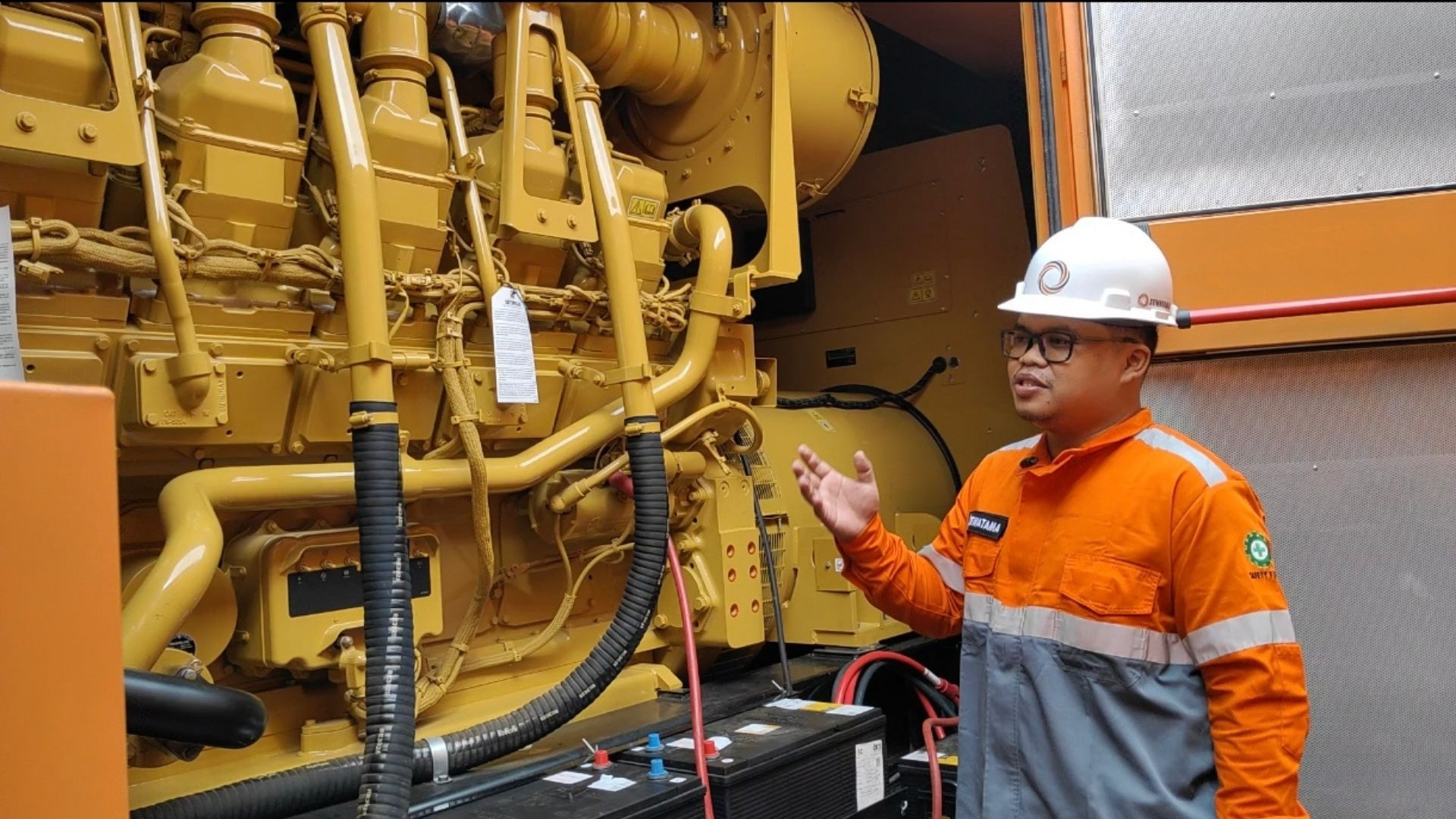
The V12 That Never Quits: Keeping the Lights On Across Remote Indonesia
Imagine living on a small island in Papua. The grid doesn't reach you; there's no connection to major power generation sources. Your only source of electricity is a generator set that must run 24 hours a day, 7 days a week, non-stop. If it stops? Your refrigerator would be no better than a wardrobe.
This scenario isn't limited to just one or two islands. Indonesia, made up of thousands of remote islands, almost certainly has many areas where the primary energy supply still depends on generator sets. The government is well aware of this challenge. On numerous occasions, it has been pushing for an interconnection system known as the smart grid, aiming to link power generation hubs with off-grid locations.
Unfortunately, building such a network cannot be done overnight. Yet the demand for electricity is a daily reality. As a compromise during this transitional period, the government is accelerating the use of B50 biodiesel, a blend of 50 percent fossil fuel and 50 percent palm oil, which is scheduled for wide-scale implementation around mid‑2026.
However, B50 is not the same as regular diesel. It has higher viscosity, higher acidity, and poses a greater challenge to engine components. This calls for a genset that is not just "tough" but genuinely reliable, capable of running day in and day out without failure.
In a city, when the power goes out, you can still fire up a standby genset or simply wait for the supply from PLN to be restored. But in remote, scattered areas, the situation is completely different. There, the genset may be the sole source of electricity.
That is why a genset for remote locations must have true continuous rating—able to run non-stop, pausing only for scheduled routine maintenance. Among the many brands and models available worldwide, one that proves its reliability is the Cat 3512B Generator Set.
Since 1981: The Beginning of a Legend
According to the July 1981 issue of Maritime Reporter magazine, the Caterpillar Engine Division officially introduced a family of high‑speed, heavy‑duty diesel engines rated from 800 to 1,600 bhp. That family was called the 3500 Series. The same publication noted that the V12 variant, the 3512, had already entered limited production for markets in the United States and Canada.
Fast forward to early 1995, when Caterpillar announced a major shift: moving the entire 3500 Series from mechanical control fuel injection to an electronic control fuel injection system. This event marked the birth of the 3512B.
Unlike its predecessor, the 3512B came equipped with Electronic Unit Injection (EUI). This technology allows for much finer fuel atomisation and more complete combustion. It also introduced the Electronic Control Module (ECM), the new "brain" of the engine, which analyses data from multiple sensors to determine, in real time, the optimal timing, duration, and volume of fuel injection.
.jpg)
The 3512 Series Family: Still Going Strong in 2026
Entering 2026, the 3512 Series remains the backbone of heavy industry worldwide. The Lafayette, Indiana, Caterpillar plant in the United States continues to produce new units, while facilities in China serve the fast‑growing Asian market.
The global trend toward renewable fuels and lower emissions is driving the adoption of gas and hydrogen‑blend configurations on the 3500 platform. The Dynamic Gas Blending feature on the latest variant (3512E) enables a seamless transition between diesel and gas, making it highly adaptable for future energy policies.
Although newer series keep appearing, the 3512B is by no means obsolete. According to a report on rogtecmagazine.com, *CNPC (China National Petroleum Corporation) still relies on the 3512B as its workhorse. They have ordered more than 1,500 units since the 1980s, adding around 100 units every year to support drilling operations across 29 countries. This fact alone proves that the 3512B's technology remains relevant even after 45 years of service.
Back in Indonesia, the national power generation company Sewatama has long partnered with the 3500 Series as its flagship. Sewatama has been operating many 3516B units since 1992, building a fleet that it rents out to various industries. Now, entering 2026, Sewatama's genset fleet is being reinforced with the latest 3512B series to complement its power rental business line.
This move by Sewatama is not just a routine addition of units. It reflects a confidence that has been tested and proven over decades: that the large 3512 family, from the B generation to the E, can endure the harshest conditions.
As a result, from the control room of a remote power plant in Papua to the far ends of the archipelago, the distinctive hum of the turbocharged V12 3512 Series will still be heard. For at least a couple of decades to come, and possibly even longer.
By Rizka S Aji, Marketing Communication, PT Sumberdaya Sewatama
Related News
Inform Us What You Need
It pleased us to provide you with solution
